Training Results of YOLOv8-m on Rice Disease Dataset

YOLOv8-m Training Results
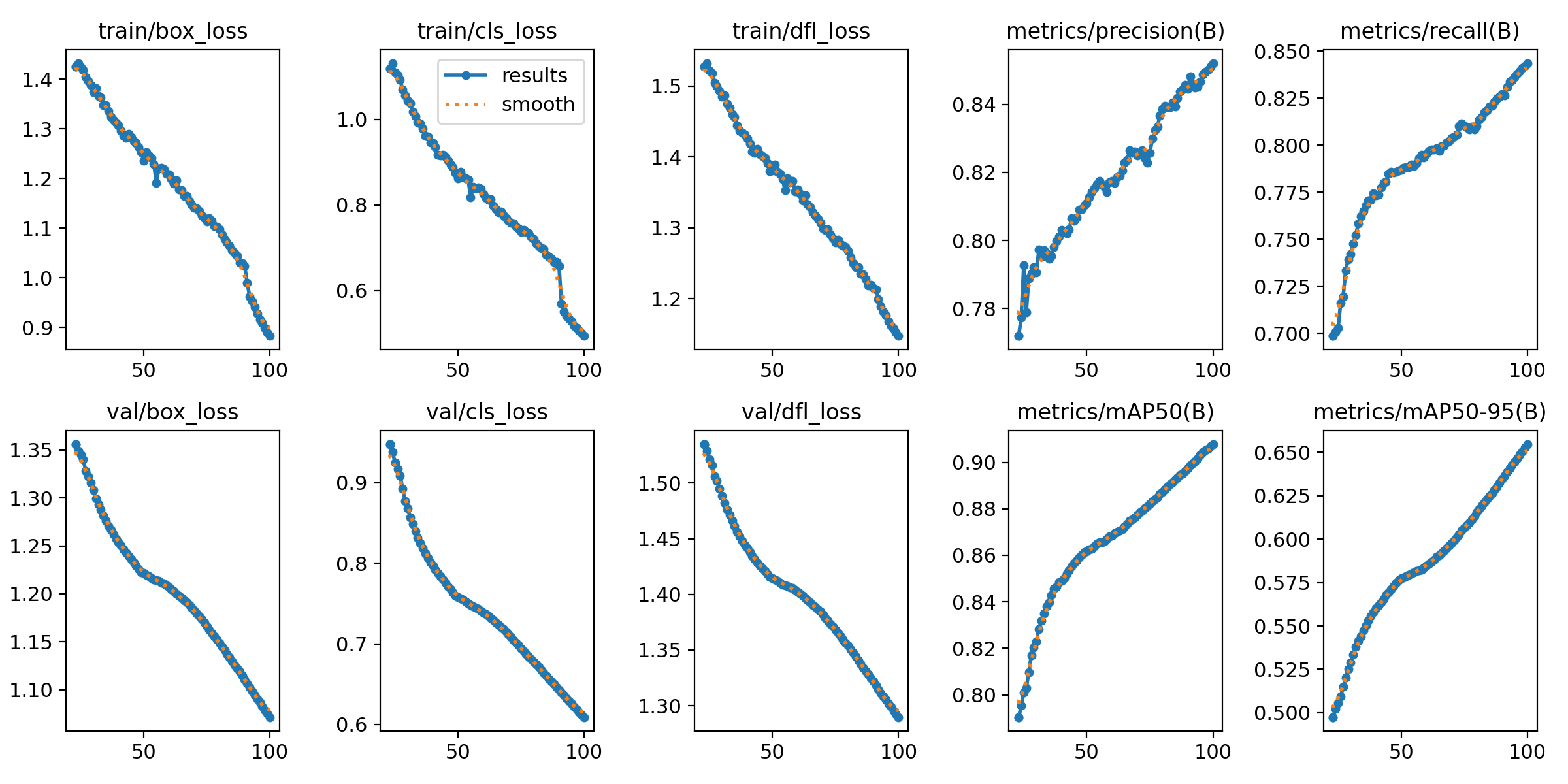
The train/box_loss plot starts around 1.4 and steadily decreases to about 0.9, indicating the model's improving ability to predict bounding box coordinates as training progresses. Similarly, the train/cls_loss begins at approximately 1.0 and drops to around 0.6, demonstrating better object classification over time. The train/dfl_loss, starting at 1.5 and decreasing to 1.2, reflects enhancements in the model's precision in localizing objects

On the validation side, the val/box_loss starts at 1.35 and declines to approximately 1.1, suggesting that the model generalizes well to unseen data for bounding box predictions. The val/cls_loss mirrors the training class loss, beginning at 0.9 and reducing to about 0.6, indicating no significant overfitting and maintaining good classification performance on the validation set. The val/dfl_loss also shows a decrease from 1.5 to about 1.3, highlighting improvements in object localization for validation data

The precision of the YOLOv8m model started at approximately 0.78 and showed a steady upward trend throughout the 100 epochs of training, ending close to 0.84. This indicates that as the training progressed, the model became increasingly adept at correctly identifying relevant instances with fewer false positives. The consistent improvement in precision suggests that the model’s ability to accurately classify objects improved significantly over time

The recall metric began around 0.70 and also exhibited an upward trend, finishing near 0.85 by the end of the training period. This upward trajectory indicates that the model’s ability to find all relevant instances within the dataset improved as training continued. The increase in recall demonstrates that the model became more effective at detecting all instances of the objects it was trained to recognize

The mAP50 metric, which measures the mean average precision at an Intersection over Union (IoU) threshold of 50% started just above 0.80 and increased steadily before plateauing near epoch 80 at about 0.90. This steady increase and eventual plateau suggest that the model’s accuracy in detecting objects with a moderate overlap criterion improved significantly during the training process. The high final value of 0.908 in mAP50 indicates that the model achieved a high level of accuracy in object detection

The mAP50-95 metric, which averages the mean average precision over IoU thresholds ranging from 50% to 95%, began around 0.52 and rose more gradually than mAP50, reaching 0.655 by epoch 100. This metric reflects a comprehensive evaluation across various levels of detection difficulty, and its consistent improvement throughout training indicates that the model became more robust and accurate across different levels of detection challenge. The gradual increase in mAP50-95 demonstrates the model’s enhanced capability to handle a range of detection scenarios

Confusion Matrix

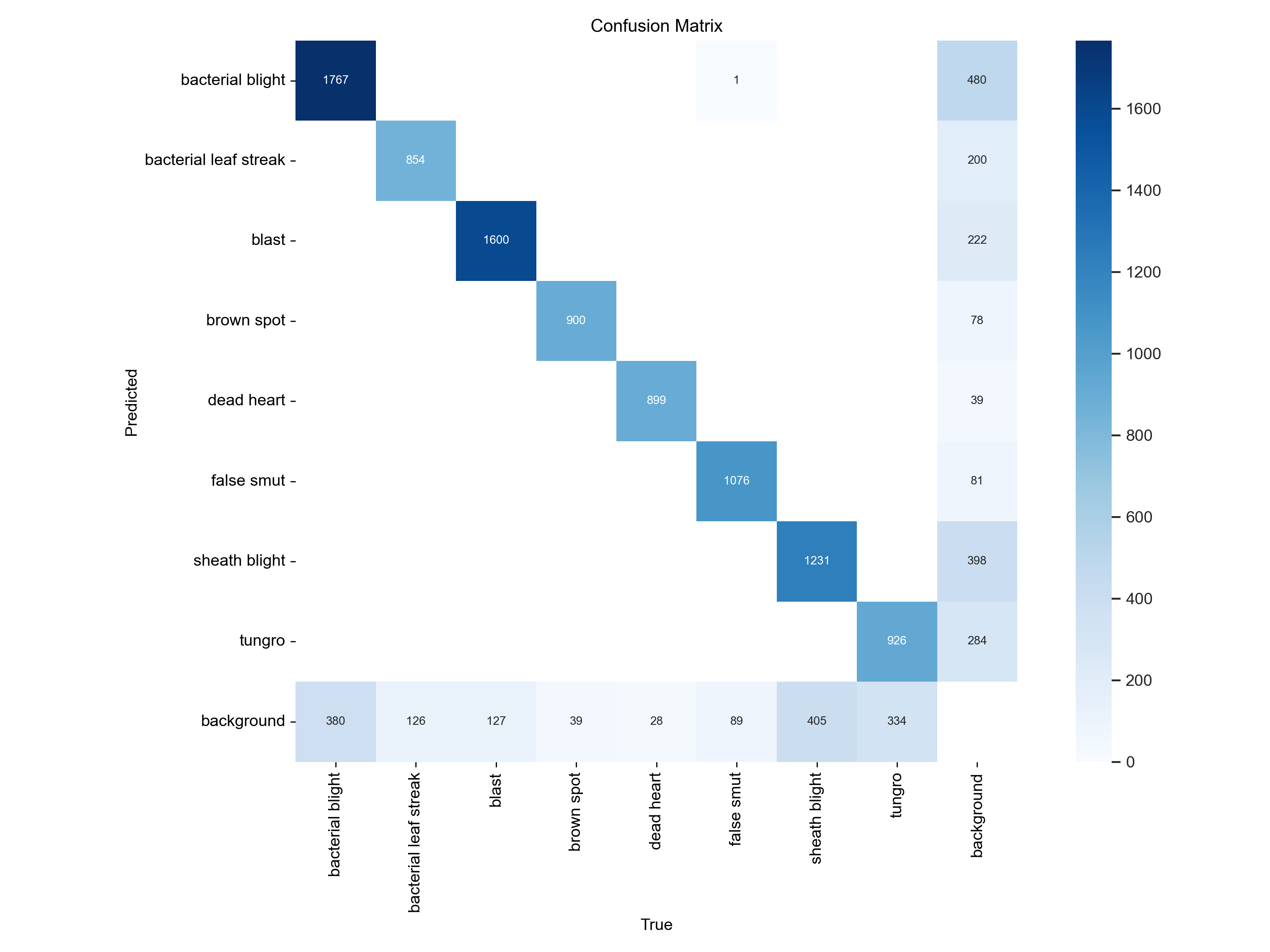
The confusion matrix for the YOLOv8m model after training shows strong performance in correctly identifying various plant diseases. The diagonal elements, representing true positives, indicate high accuracy for most classes, such as bacterial blight with 1767 correct predictions and tungro with 926 correct predictions. The matrix also includes a row and column for the background class, which represents instances where the model correctly identifies that no disease is present. High values along the diagonal for the background class indicate that the model is effectively distinguishing between diseased and non-diseased areas.

Conversely, off-diagonal values in the background row or column would indicate misclassifications, where the model either incorrectly labels background as a disease (false positive) or fails to detect a disease and labels it as background (false negative). The matrix shows instances where there are misclassifications of diseases incorrectly classified as background. Overall, the model demonstrates robust classification capabilities, though there is room for improvement in reducing misclassifications between disease classes

Precision - Recall Curve
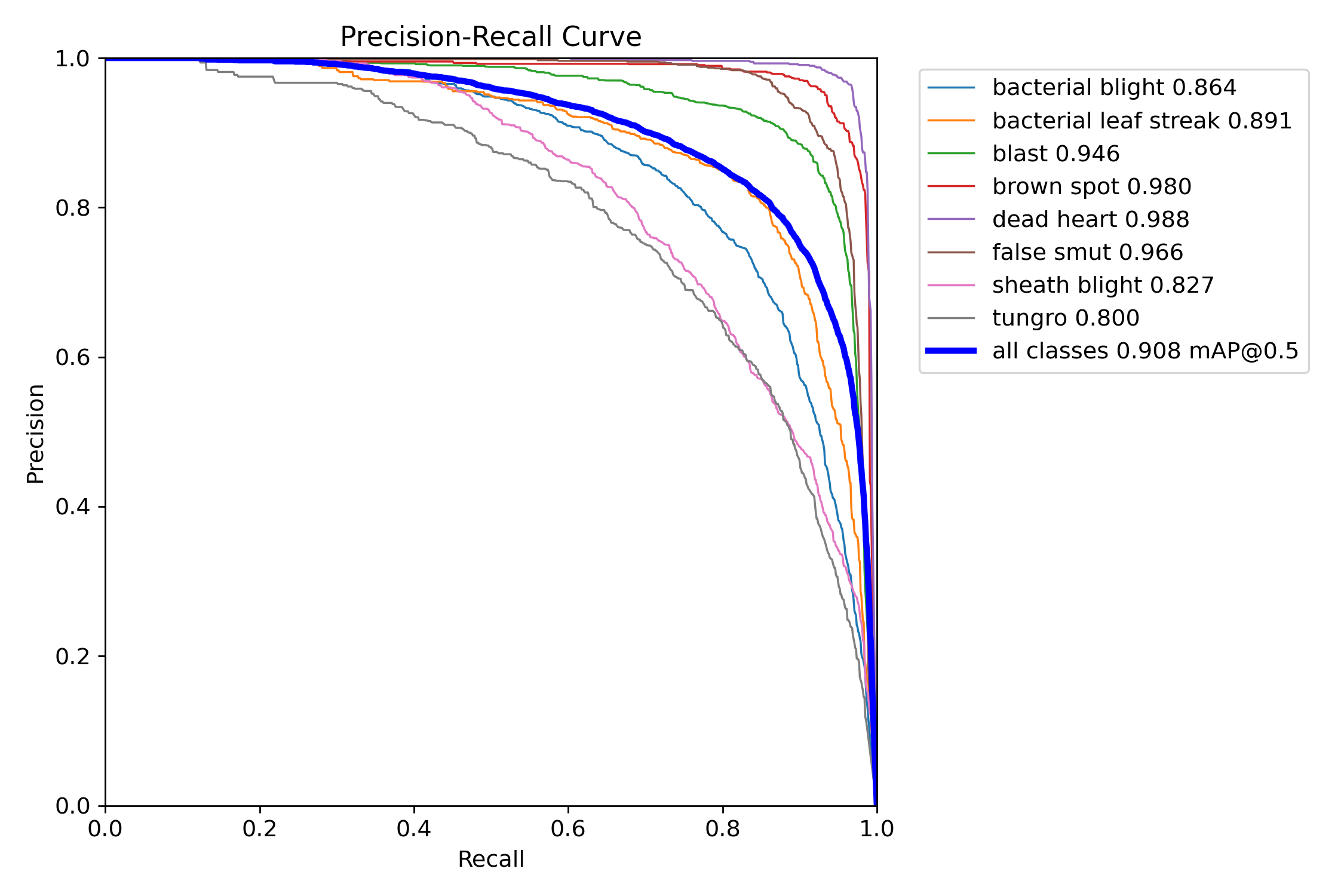
The precision-recall curve for the YOLOv8m model after training provides a detailed view of the model’s performance across different classes. Each curve represents a different class, showing how precision and recall trade off at various thresholds. The dark blue line represents the combined performance across all classes, with an overall mean average precision (mAP) of 0.908 at an IoU threshold of 0.5. This curve indicates that the model performs well across different classes, maintaining a good balance between precision and recall